

Review · OSAKA
Osaka: Castle History Walking Tour / Castle Tower Admission
Osaka Castle was built to make an attacking army miserable. You will follow the old approach through moats, gates, sharp turns, and high stone walls, then learn how each feature slowed, split, or exposed an enemy. The castle’s largest stone and the climb to the tower add two memorable payoffs.
I especially like the way the guide explains the castle as a working military machine, not just a pretty landmark. I also like the separate entrance to the tower, which can save time, particularly on busy mornings. The main consideration is pace: you will walk outdoors, and the tour does not provide a guided explanation of every floor inside the museum.
Key points
- See the castle as a fortress: Trace triple moats, layered gates, and zigzag routes designed to trap attackers.
- Study the giant stone: Learn how builders moved Osaka Castle’s largest stone in the 16th century.
- Spot details you could miss alone: Guides point out hidden marks left by the master stoneworkers.
- Enter through a separate entrance: The skip-the-line arrangement can be useful when queues build.
- Visit Hokoku Shrine: Add a short cultural stop connected to Toyotomi Hideyoshi, the castle’s founder.
- Reach the tower roof level: Enjoy Osaka views after learning why the tower served as both command post and final refuge.
Why Osaka Castle Makes More Sense as a Military Tour
Osaka Castle is easy to admire and surprisingly easy to misunderstand. Its bright tower, gold details, and broad grounds can make it feel like a grand symbol first and a fortress second. This tour reverses that order.
Your guide begins with the practical question: how would an army get inside? The answer is not simply climb the wall. Attackers faced several defensive layers, including outer moats, inner moats, thick stone walls, multiple gates, and routes that refused to run in a straight line.
That approach gives the visit a useful focus. Instead of hearing a string of dates, you learn how the site worked. A gate could force soldiers into a narrow space. A sharp turn could slow a large group. A wall angle could expose men to fire while giving defenders protection.
The castle’s defenses were designed to delay and divide an attacking force. That matters because a fortress did not need to stop every enemy at the first wall. It needed to keep the enemy confused, separated, and vulnerable long enough for defenders to respond.
More Castle Walking Tours in Japan
- Ultimate Osaka Walking Tour: Castle, Dotonbori & Hidden Gems
★ 5.0 · 862 reviews - Osaka Castle Walking Tour and Castle Tower Admission
★ 5.0 · 561 reviews - Osaka: Osaka Castle 3 hours Historical Walking Tour
★ 4.6 · 14 reviews
Meeting at Lawson S Otemae Rest House Store
The meeting point is in front of Lawson S Otemae Rest House Store. This detail matters because there are several Lawson stores nearby. Use the supplied Google Maps location rather than relying on the shop name alone, and look for the Local Guide Stars sign.
Arrive ready to walk. Comfortable shoes are important, since the route crosses historical grounds, stone paths, and outdoor approaches. You should also dress for the weather. The castle grounds are open-air, and the tour does not let you stay under cover for the entire time.
The English-speaking guides include people such as Mao, Spike, Saya, Yuta, Ken, Kaz, Yu, and others. The experience can feel different depending on who leads it, but the strongest pattern is clear: guides explain the history in an approachable way, answer questions, and adjust their pace when someone needs more time.
One useful point from the guide team is its attention to comfort. Some guides have slowed down for older participants, waited for delayed arrivals, or allowed time for photographs without dropping the historical explanation. That is helpful for families and mixed-age groups.
Reading the Triple Moats and Layered Gates
The first major part of the walk takes you through the outer defenses. Look for the triple moat system and the sequence of gates that once forced an army to keep changing direction.
A straight road to the tower would have been a gift to attackers. Osaka Castle offered almost the opposite. The route bends, narrows, and passes through gates arranged to create masugata entrances. These square or boxed-in entry areas could trap an invading group between gates while defenders attacked from protected positions.
Your guide will point out the zigzagging paths that soldiers once faced under fire. The point was not merely to make the castle attractive or confusing. The turns broke up momentum and made it hard for attackers to see what waited ahead.
This is one of the best reasons to take the tour rather than walk straight to the tower on your own. You can see the stones without understanding the plan. With a guide, the walls and gates become a sequence of deliberate problems placed in an enemy’s path.
The outdoor portion also gives you time to take photographs. The main tower is the obvious subject, but the walls, water, turrets, and gate approaches show the fortress in a more useful way. Several guides are good at positioning the group at photo spots without turning the whole outing into a photo session.
The Largest Stone and the Craft Behind the Walls
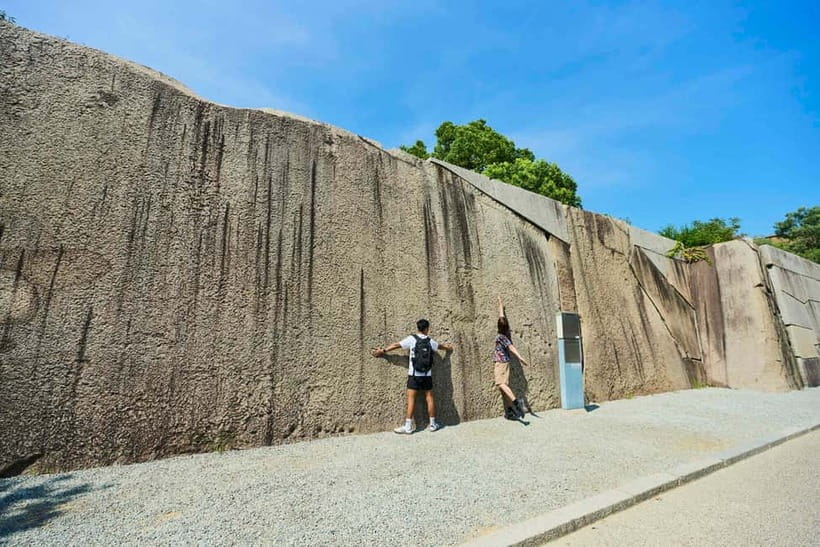
The tour pauses at the castle’s largest stone, one of the most striking physical features of the grounds. The story here is practical: how did workers move a huge block in the 16th century, long before modern cranes and trucks?
The answer helps you picture the labor behind Osaka Castle. The stone walls were not assembled from identical factory-made pieces. Large blocks had to be selected, transported, positioned, and fitted with care.
You will also look for marks associated with the master craftsmen. These small signs can be easy to miss when you are focused on the tower. They add a human touch to an otherwise massive military project, showing that individual teams left their mark on the work.
The walls themselves deserve attention. Their angles and tight stonework were intended to make climbing difficult. A smooth-looking surface was not an accident. The construction turned the wall into a barrier that demanded time and effort from anyone trying to get over it.
For me, this is where the tour earns much of its price. The admission ticket gets you into the castle, but the guide gives you a reason to stop beside a particular stone, wall, or mark. That extra context is especially useful if you do not already know much about Japanese castle design.
More Castle Walking Tours in Osaka:
- 1-Day walking tour in Osaka:Castle, temples and Ukiyoe
★ 5.0 · 4 reviews - Edinburgh Castle: Guided Walking Tour with Entry Ticket
★ 4.7 · 11,699 reviews - Prague: 3-Hour Walking Tour of Old Town & Prague Castle
★ 4.7 · 5,696 reviews - Edinburgh Castle: Guided Walking Tour with Entry Ticket
★ 5.0 · 5,540 reviews
Hokoku Shrine and the Toyotomi Connection
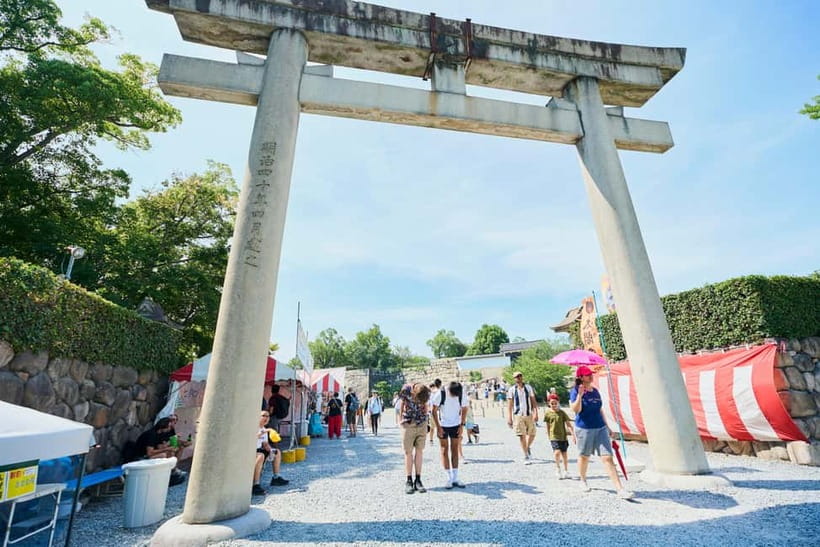
The walk includes a guided visit to Hokoku Shrine, a short stop that connects the grounds to Toyotomi Hideyoshi. Hideyoshi is central to Osaka Castle’s identity, and the shrine gives the tour a cultural pause between the fortress defenses and the tower.
Expect about 20 minutes at the shrine as part of the planned route. The guide can place Hideyoshi’s legacy in the larger story of Osaka and explain why this site matters. You may also encounter an active religious or cultural moment. One participant happened to see a traditional Japanese wedding ceremony during the visit, though ceremonies are not guaranteed.
This stop is not a substitute for a full shrine tour. Its value is in the connection. The castle is not only a set of walls and views. It is also tied to the memory of the leader who made Osaka a major center of power.
If you are mainly interested in military architecture, the shrine section may feel less central than the moats and gates. If you want a broader understanding of the place, it rounds out the visit nicely.
Inside the Tower: Command Center, Museum, and Viewpoint
The tour includes admission to Osaka Castle Tower through a separate entrance. This is advertised as skip-the-line access, and it can be especially useful when the regular ticket or elevator queues grow.
Timing matters. One 9 a.m. group was leaving around 11 a.m., when lines had become much longer. An early start can also put you near the castle before the surrounding food stalls are fully active, which may suit you if you prefer sightseeing first and lunch later.
Inside, the tower functions as a museum as well as a viewpoint. The guided portion takes you to the tower, but the tour does not include a guide on every museum floor. You should think of the ticket as a chance to continue independently after the main explanation.
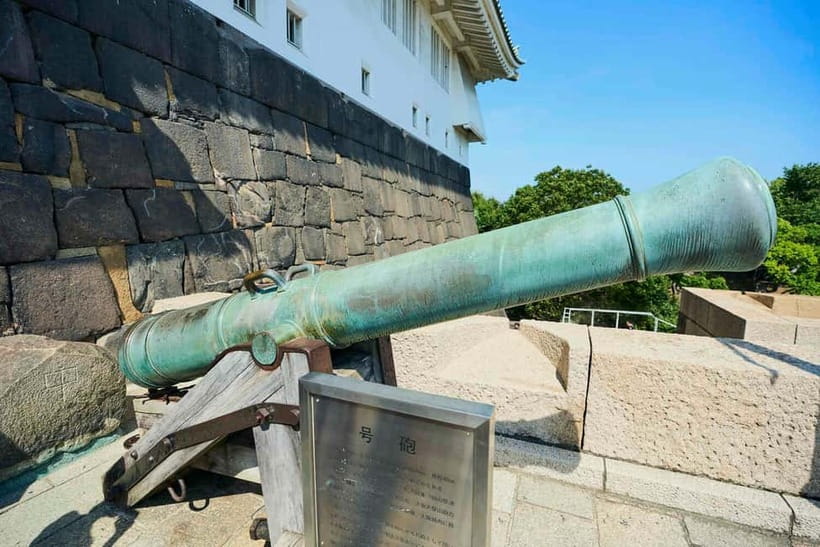
The tower itself once had a military purpose. Guides discuss arrow slits, gun ports, and the role of the upper structure as a command post and last defensive position. These features show that the tower was not only a place for rulers to look out over their domain.
Gold also played a role. Its use was not merely decorative. Bright surfaces could project wealth and power, impress allies, and unsettle enemies. That blend of defense and psychological warfare is one of the more interesting parts of the explanation.
At the top, you get a city view that makes the earlier discussion easier to grasp. From above, the scale of the grounds and the position of the castle become clearer. The view is a reward, but it is more meaningful after you have walked the approaches and understood why the castle was built where it was.
The Fall of an Apparently Invincible Fortress
The tour ends its historical story with the Osaka campaigns of 1614 and 1615. This is the part that prevents the castle from becoming a simple tale of Toyotomi strength.
The fortress was designed to resist attack, yet it fell during the fierce struggle between the legacy of Toyotomi Hideyoshi and the ambition of Tokugawa Ieyasu. The result shows that strong walls alone cannot settle a political contest.
You will hear how the castle’s reputation as an almost unbeatable stronghold met the realities of changing alliances, military pressure, and leadership. The point is not that the defensive design failed to work. It is that no fortress exists outside politics and strategy.
This final chapter gives the visit a satisfying shape. You begin by seeing how the castle could delay an army, then finish by asking why even such a careful defense could not preserve the Toyotomi cause.
How Much Does the $33 Price Buy You?
At $33 per person, this is more expensive than simply visiting Osaka Castle on your own. The value comes from three things: the professional English-speaking guide, the castle tower admission, and the separate entrance that can reduce time spent in line.
If you already know Japanese castle architecture and plan to read every museum display yourself, the added cost may not be essential. You can visit the grounds independently and set your own pace.
For most first-time visitors, I think the price is reasonable. Osaka Castle covers a large area, and many of its most interesting features are easy to walk past without explanation. The guide turns the outer moats, wall angles, gate layout, giant stone, and hidden marks into a connected story.
The strongest value appears when your time in Osaka is limited. A 90-minute guided visit gives you a clear route and a focused explanation, then leaves you able to continue on your own inside the tower. You are paying less for luxury than for orientation and saved time.
The tour has a 4.9 rating from 230 bookings, and the guide team receives repeated praise for warmth, clear English, historical detail, and good photo stops. Names that come up often include Spike, Mao, Saya, Yuta, Ken, Kaz, Yu, and Ami. Individual guide styles will vary, but the experience is built around a personal explanation rather than an audio guide.
Who Will Enjoy This Walk Most?
I would choose this for you if you like understanding why a place was built, not just photographing it. It suits people interested in military strategy, architecture, Japanese history, and the rise and fall of powerful families.
Families can also do well here. One guide kept a three-year-old engaged, and another managed the pace carefully for an older participant. That does not mean every child will enjoy 90 minutes of castle history, but the route has physical features, stories, and views to break up the explanation.
It is also a good choice for solo visitors or small groups. A solo participant once received a nearly private experience when nobody else arrived, though you should not book expecting that arrangement.
You may want to skip it if you dislike walking outdoors, prefer complete freedom to stop at every display, or want a fully guided museum visit on each tower floor. The tour explains the main design and history, but it does not replace independent time inside the museum.
Practical Details Before You Book
Plan for 90 minutes, while allowing some flexibility around admission lines, group movement, and time spent taking photographs. The listed stops include the castle grounds, Hokoku Shrine, and the tower, with the outdoor walking forming the core of the visit.
Wear comfortable shoes and bring clothing suited to the weather. The historical sites are spread across open grounds, and the experience depends on moving between defensive features rather than standing in one indoor room.
Check the exact Lawson meeting point carefully. Several Lawson stores are in the area, so the Google Maps pin is more reliable than searching casually after you arrive.
The booking allows cancellation up to 24 hours before the start for a full refund. You can also reserve now and pay later, which helps if your Osaka schedule is still changing.
Should You Book the Osaka Castle Tour?
Book it if you want Osaka Castle to make sense as a fortress, not just as a photogenic tower. The best parts are the explanation of the triple moats and masugata gates, the giant stone, the overlooked marks in the masonry, and the story of the castle’s fall in 1614 and 1615.
The separate entrance is another practical advantage, especially for a morning visit when queues can grow. You will also get time at the top for city views and some independent museum browsing.
Skip it if you are content to wander without context or if your main goal is a slow, floor-by-floor museum visit. For everyone else, $33 buys a focused route, a human guide, admission to the tower, and a much clearer idea of how Osaka Castle was meant to work.
FAQ
How long does the Osaka Castle walking tour last?
The activity is listed as 90 minutes. The route includes guided time around Osaka Castle, a visit to Hokoku Shrine, and time at the castle tower.
Is Osaka Castle admission included?
Yes. The Osaka Castle Tower admission ticket is included in the price.
Does the guide explain every floor inside the castle museum?
No. The ticket is included, but a guided tour of every museum floor is not. After the main guided visit, you can explore the tower on your own.
Is the tour conducted in English?
Yes. The tour has a live English-speaking guide.
Where is the meeting point?
Meet in front of Lawson S Otemae Rest House Store. Several Lawson stores are nearby, so check the supplied Google Maps location and look for the Local Guide Stars sign.
What should I bring?
Wear comfortable shoes and clothing suited to the weather. The tour involves walking through outdoor historical areas, including castle grounds, moats, gates, and stone walls.
More history behind the walls around Osaka
- Osaka: Osaka Castle & Historical Museum Guided Tour
★ 4.8 · 28 reviews - Edinburgh: Edinburgh Castle Guided History Tour with Tickets
★ 4.8 · 9,933 reviews - Charleston historical walking tour with a Professor of History at The Citadel
★ 5.0 · 1,284 reviews - Buda Castle District Dark History, Legends and Vampire Night Tour
★ 4.5 · 1,240 reviews
New castle tours around Osaka
- From Osaka: Himeji Castle, Arima Onsen & Mt. Rokko Day Tour★ 4.6 · 339 reviews
- Osaka: Osaka Castle 3 hours Historical Walking Tour★ 4.6 · 14 reviews
- Osaka: Osaka Castle Guided Tour with Local Guide★ 4.7 · 78 reviews
- Osaka: Osaka Castle – Tsuruhashi – Tennoji (Spanish Guide)★ 4.7 · 10 reviews
- Osaka: Castle, Tea Ceremony, Calligraphy, and Samurai Armor!★ 5.0 · 4 reviews
- Osaka: Early Morning Osaka Castle Guided Tour, Avoid Crowds★ 4.9 · 12 reviews
- Osaka: Explore Every Bit of Osaka Castle in 3 Hours★ 5.0 · 5 reviews
- Osaka: Osaka Castle & Historical Museum Guided Tour★ 4.8 · 28 reviews
Castle Walking Tours, compared.

Edinburgh Castle: Guided Walking Tour with Entry Ticket
Read our review →
Prague: 3-Hour Walking Tour of Old Town & Prague Castle
Read our review →
Edinburgh Castle Guided Walking Tour in English
Read our review →
Budapest: Buda Castle Walk with Saint Stephen’s Hall
Read our review →

Prague 3-hour Afternoon Walking Tour including Prague Castle
Read our review →
Royal Mile and Edinburgh Castle – Small Group Walking Tour
Read our review →
Browse the lists this tour appears in