

Review · THE USA
Charleston historical walking tour with a Professor of History at The Citadel
Charleston’s past comes at you fast on this three-hour walk with Eric Lager, Ph.D., a history professor at The Citadel. You move from colonial churches and an old statehouse to the streets where the Civil War began, with the city’s architecture serving as the evidence. This is not a quick roll call of pretty houses. It is a serious look at how religion, trade, politics, slavery, war, and civic life shaped Charleston.
I like the small cap of 12 people, which makes it easy to hear and ask questions. I also like the route’s ending at the Battery, where Fort Sumter sits across the harbor and Rainbow Row is close by. The main consideration is pace: you cover a lot of ground and receive a lot of information, so this suits curious walkers more than people seeking a slow photo stroll.
Key points before you book
- A real history lesson: Eric Lager brings a Ph.D. in nineteenth-century American and European history and teaches at The Citadel.
- Small group format: The tour is limited to 12 people, allowing direct questions and conversation.
- A broad time span: Expect stories reaching from the colonial era through the American Revolution, the Civil War, and later Charleston.
- Thirteen important stops: Churches, civic buildings, a theater, the French Quarter, and harbor views all fit into the route.
- No Fort Sumter boat trip: You see the fort from the Battery. The tour does not travel out to the island.
- Plan for steady walking: Good weather is required, and a moderate level of fitness is recommended.
Why this Charleston walk feels different

Many city walks give you a building, a date, and a quick anecdote before moving on. This one aims for connections. At Charleston City Hall, for example, you learn how one building served as a meat market and a bank before becoming the seat of city government. At the Charleston County Courthouse, the story reaches back to the building’s earlier role as South Carolina’s statehouse.
That approach matters because Charleston can look like a collection of handsome facades unless somebody explains the forces behind them. Eric’s academic background is useful here, particularly when the discussion moves beyond architecture into politics, religious life, and the causes of disunion. His teaching style also appears to be conversational rather than stiff. He invites questions, answers side topics, and keeps the walk moving.
The group size helps. With no more than 12 people, you are not trying to hear a guide from half a block away. You can also ask about a particular building, period, or person while the subject is still in front of you. That is a strong reason to choose this walk over a much larger city tour.
The tradeoff is density. Three hours is a long time to walk and listen, especially in heat, rain, or cold. You may leave with a notebook’s worth of names and dates rather than a light introduction. If that sounds appealing, this is a good match. If you want only a few broad stories and plenty of unstructured wandering, choose a shorter walk.
More fortresses and citadels around the world:
- Carcassonne: Castle and Ramparts Entry Ticket
★ 4.6 · 2,884 reviews - Salzburg: Hohensalzburg Fortress Admission Ticket
★ 4.6 · 2,236 reviews - Salzburg: Best of Mozart Fortress Concert and Dinner
★ 4.5 · 1,424 reviews
Meeting at 108 Meeting Street
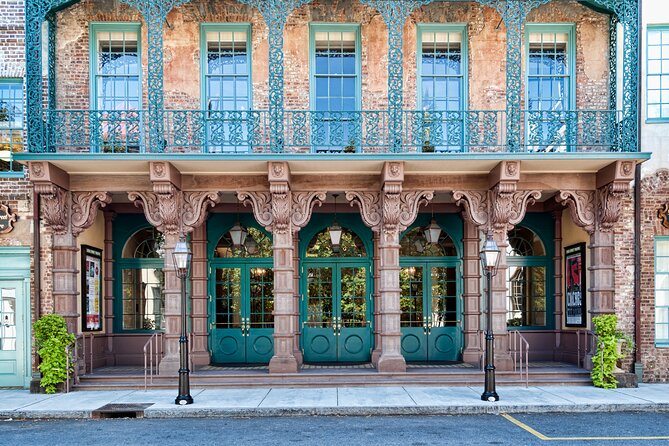
The tour starts at 108 Meeting Street, in front of the Mills House Charleston, Curio Collection by Hilton. From there, the route heads into the historic center and stays focused on the old city rather than spreading across the wider Charleston area.
The Mills House is not just a convenient starting point. Its story reaches into the early Civil War, giving Eric an immediate way to frame Charleston as a city where grand architecture and national conflict often occupy the same block. The stop lasts about 10 minutes, enough time to establish the period and the themes that will return later.
Meeting Street is near public transportation, but private transport is not included. Plan to arrive ready to walk rather than expecting a vehicle between stops. The route finishes at 39 East Battery, near Rainbow Row, so you do not return to the starting point.
The theater, Pink House, and Charleston’s early city
The next stop is Dock Street Theater, where the focus shifts to entertainment and the people who made Charleston’s early social life more complicated than its polished streets might suggest. The building is associated with the first theater built in North America, and the discussion includes some of the colorful and infamous figures tied to its story.
That makes this more than an architecture stop. A theater tells you who had leisure, money, and social influence, while the characters connected to it reveal the less tidy side of city life. You spend about 10 minutes here.
The Pink House Gallery follows. Dating to about 1712, it is one of Charleston’s oldest buildings. The stop is brief, about five minutes, but its age makes it useful. You get a clear sense of how much of the city’s story is tied to structures that have survived through changes in government, commerce, and war.
I would not expect an interior visit at either stop. The value comes from seeing the buildings in place and hearing how they fit into the city’s growth.
Washington Square and the civic heart
Washington Square is a longer stop, about 15 minutes, and gives you a chance to consider Charleston as a political city. The square contains several monuments, and its open space provides a break from the close street pattern of the French Quarter.
From there, the walk moves to Charleston City Hall. Its changing use is one of the route’s more useful lessons. A building that began as a meat market and later served as a bank eventually became City Hall. That sequence reflects a growing city adapting older structures to new civic needs.
The Charleston County Courthouse adds another layer. It occupies the site of what was once the old South Carolina statehouse, placing state politics directly into the route. This is where the guide’s broad approach pays off. You are not only looking at buildings. You are tracing the movement of power through the city.
These three stops also help explain why Charleston’s old center can feel so concentrated. Commercial life, government, religion, and public ceremony developed within a compact area. You do not need a bus to understand the pattern because the walk keeps the relationships visible.
More Castle Walking Tours in the world:
- Edinburgh Castle: Guided Walking Tour with Entry Ticket
★ 4.7 · 11,699 reviews - Prague: 3-Hour Walking Tour of Old Town & Prague Castle
★ 4.7 · 5,696 reviews - Edinburgh Castle: Guided Walking Tour with Entry Ticket
★ 5.0 · 5,540 reviews - Edinburgh Castle Guided Walking Tour in English
★ 5.0 · 5,214 reviews
St. Michael’s Church and two centuries of faith
St. Michael’s Church is one of the tour’s key architectural and historical stops. Completed in 1761, it is the oldest church edifice in Charleston. The discussion places the building within the city’s religious and civic life, rather than treating it as a pretty church to photograph from the sidewalk.
You spend around 10 minutes here. That is enough for a focused explanation, though anyone hoping to tour every interior on the route should know that this is a walking history experience, not an admission-based church circuit.
The French Huguenot Church later adds another religious thread. Eric explains the role of French Huguenots in Charleston and introduces the church as the first built in the Gothic Revival style. Together, these stops show that Charleston’s identity was never shaped by one tradition alone.
I especially like the pairing. St. Michael’s points to the city’s early Anglican establishment, while the French Huguenot Church brings in migration, religious difference, and architectural change. You get more from them together than you would from either one as an isolated photo stop.
George Washington and the Old Exchange
The Heyward-Washington House marks a shift from public buildings to personal history. George Washington stayed there during his Charleston visit in 1791. The house helps connect the city to the early national period and gives the route a specific domestic setting for a major figure.
Admission to the Heyward-Washington House is not included, so the stop should be understood as an exterior visit and historical explanation unless you arrange entry separately. The scheduled discussion lasts about 10 minutes.
The Old Exchange and Provost Dungeon brings you back to public power. It was the last public building built by the British in North America, and the Constitution was ratified there in 1788. The building also has a darker association with imprisonment, which gives the stop more weight than its grand exterior might suggest.
Admission is not included here either. That is worth noting if you hoped to see the dungeon inside. The tour can explain the site and its role, but it does not turn the walking ticket into an all-access pass for Charleston’s museums and houses.
The French Quarter and Hibernian Hall
The French Quarter is one of the most enjoyable sections for simply looking around. The route gives you about 15 minutes to take in its streets and buildings, while Eric explains why this part of Charleston developed its particular character.
This is also where the tour can feel less like a classroom and more like a city walk. The French Quarter’s charm is easy to notice, but the guide gives you reasons behind the appearance rather than leaving the beauty unexplained. Keep your camera ready, but listen closely. The context is the point.
At Hibernian Hall, the subject turns sharper. The building is tied to the early causes of disunion, and Eric discusses America’s connection to Greek Revival architecture. This is one of the stops where political history and design meet directly.
Admission to Hibernian Hall is not included. The stop lasts about 10 minutes, and its importance comes from the story attached to the building. You will likely find the discussion more valuable if you have an interest in the years before the Civil War, when arguments over state power, slavery, and national identity were hardening.
The Battery and the view toward Fort Sumter
The final major stop is Fort Sumter National Monument, viewed from the Battery on Charleston Harbor. This is where the first shots of the Civil War were fired, but the tour does not take you out to the fort.
That distinction matters. If you want to walk around Fort Sumter itself, you need a separate boat excursion. Here, the point is the view and the explanation. Standing at the Battery while looking toward the fort gives the event a physical setting, even without the longer trip across the water.
The tour ends at 39 East Battery, near the Rainbow Row section of Charleston. That is a practical finish. You are already in a good area for more sightseeing, photographs, or a separate visit to the waterfront. It also means you can plan the walk as an introduction to the old city, then continue exploring on foot afterward.
What three hours and $40 buy you
At $40 per person, the tour is priced as a focused educational walk rather than a simple orientation stroll. I think the value is strongest if you care about context, ask questions, and want one guide to connect several centuries of Charleston history.
The route covers at least 13 named sites, but the number alone is not the main value. You are paying for Eric’s ability to explain why the sites matter and how they relate. A guide with doctoral training and classroom experience can answer questions that fall outside a memorized script, which is particularly useful in a city with complicated political and social history.
The small group also matters at this price. A limit of 12 gives you a better chance to hear every explanation and take part in the conversation. Several people who took the walk describe Eric as funny, personable, and willing to spend time on questions. Those traits matter because three hours of facts can become tiring without a human connection.
There are limits. Bottled water is not provided, and private transport is not part of the experience. The route requires moderate physical fitness, and weather can cancel the walk. You receive a full refund or a different date if poor weather forces cancellation, but you should still plan for Charleston’s conditions with sensible shoes, water, and protection from sun or rain.
You can cancel for a full refund up to 24 hours before the start time. Cancellations inside that window are not refunded, and last-minute changes are not accepted.
Who should book this walk?
I would choose this tour early in a Charleston visit if I wanted a strong framework for the city. One person who took it described it as a way to get ideas for other places to explore, and that is exactly how the route can work. Once you understand the churches, squares, civic buildings, and harbor, later sightseeing becomes easier to place.
It is especially suited to:
- History and architecture enthusiasts
- Couples or solo visitors who enjoy asking questions
- People interested in the Revolution, the Civil War, and Charleston politics
- Small groups who prefer direct contact with a guide
- Anyone who wants more substance than a standard sightseeing loop
It may be less suitable for young children who need frequent activity changes, anyone with difficulty walking for three hours, or people who want extensive interior visits. The route is also not the best choice if your main goal is Fort Sumter itself, since you only view it from the Battery.
Should you book Charleston History Walk?
Book it if you want Charleston explained by a trained historian rather than reduced to a series of famous names and attractive buildings. Eric Lager’s mix of academic depth, humor, and conversation gives the walk its strongest advantage, while the group limit keeps the experience personal.
Skip it if you prefer a relaxed photo walk, dislike long discussions, or need a vehicle between stops. For the right audience, though, $40 buys a compact tour through Charleston’s colonial, revolutionary, religious, political, and Civil War past, with a memorable harbor finish.
FAQ
How long is the Charleston historical walking tour?
The tour lasts about three hours.
How much does the tour cost?
The price is $40 per person.
Who leads the tour?
The tour is led by Eric Lager, Ph.D., a professor of history at The Citadel.
How large is the group?
The group is limited to a maximum of 12 people.
Where does the tour start?
It starts at 108 Meeting Street in Charleston, South Carolina, at the Mills House Charleston, Curio Collection by Hilton.
Where does the tour end?
It ends at 39 East Battery, near the Rainbow Row section of Charleston.
Do you visit Fort Sumter?
You view Fort Sumter National Monument from the Battery on Charleston Harbor. The tour does not travel out to the fort.
Are admission fees to the historic houses included?
Admission to the Heyward-Washington House, Old Exchange and Provost Dungeon, and Hibernian Hall is not included. The tour price includes all listed fees and taxes.
Is bottled water included?
No. Bottled water is not provided.
Can I cancel for a refund?
You can receive a full refund if you cancel at least 24 hours before the experience start time. Cancellations within 24 hours are not refunded. If poor weather cancels the tour, you are offered another date or a full refund.
More history behind the walls around the world
- Edinburgh: Edinburgh Castle Guided History Tour with Tickets
★ 4.8 · 9,933 reviews - Buda Castle District Dark History, Legends and Vampire Night Tour
★ 4.5 · 1,240 reviews - Luxembourg: Nature, History and Castles Full-Day Tour
★ 4.5 · 529 reviews - Dublin to Cork, Blarney Castle & Cóbh Heritage Centre by train
★ 4.5 · 510 reviews
New castle tours around the world
- From Prague: Karlštejn Castle & Koněprusy Caves Tour★ 4.9 · 183 reviews
- Prague: 2.5-Hour Vyšehrad Castle with Gorlice & Tickets★ 4.5 · 118 reviews
- Prague: Alchemy & Mysteries Bridge and Castle Evening Tour★ 5.0 · 8 reviews
- Prague Castle: 1-Hour Introduction Tour with Entry Ticket★ 4.2 · 41 reviews
- Potsdam: The evening Wannsee tour. Castles, parks, and villas.★ 4.7 · 63 reviews
- Prague: Stunning Viewpoints, Castle, City & Park Bike Tour★ 4.6 · 38 reviews
- Prague: River & Park Bike Tour to Troja Chateau★ 5.0 · 8 reviews
- Ljubljana: Postojna cave & Predjama castle small group tour★ 4.9 · 29 reviews
Fortress & Citadel Tours, compared.

Carcassonne: Castle and Ramparts Entry Ticket
Read our review →
Salzburg: Hohensalzburg Fortress Admission Ticket
Read our review →
Salzburg: Best of Mozart Fortress Concert and Dinner
Read our review →
From Cairo Alexandria Catacombs, Citadel Day Trip with Lunch
Read our review →
Hue Customizable Tour with Imperial Citadel & Forbidden City
Read our review →
Desert Safari: Luxury Fortress Dinner, Camel Ride & Dune Bashing
Read our review →
Cairo: Egyptian Museum, Citadel, and Old Cairo Guided Tour
Read our review →
Cairo Citadel, Old Cairo and Khan El Khalili: Private Tour
Read our review →Browse the lists this tour appears in