
Review · CORDOBA
Guided visit to the Mosque of Cordoba and Alcazar of Cordoba
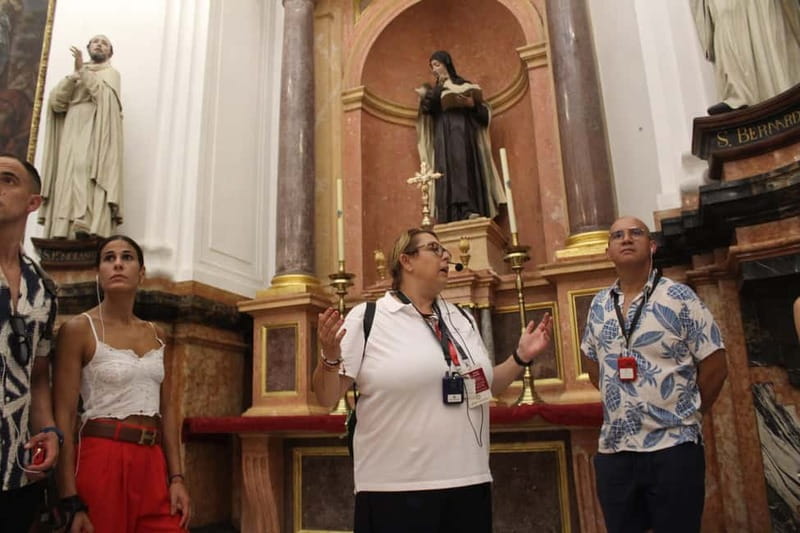
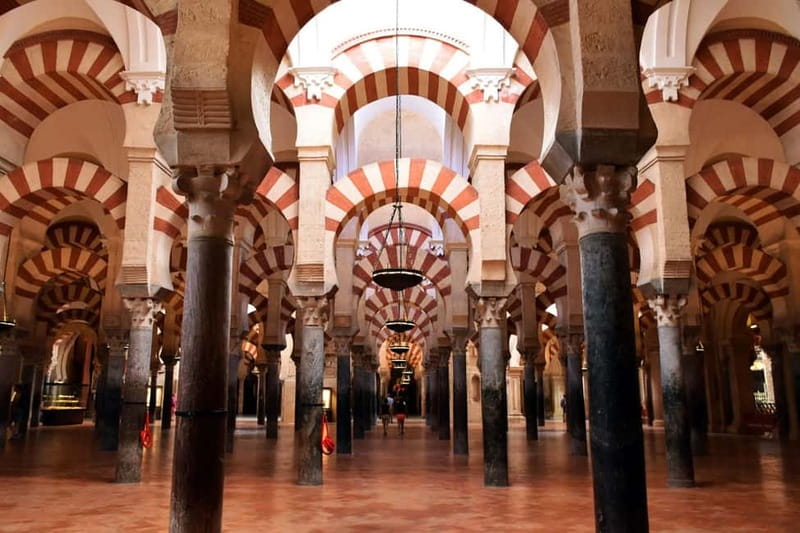
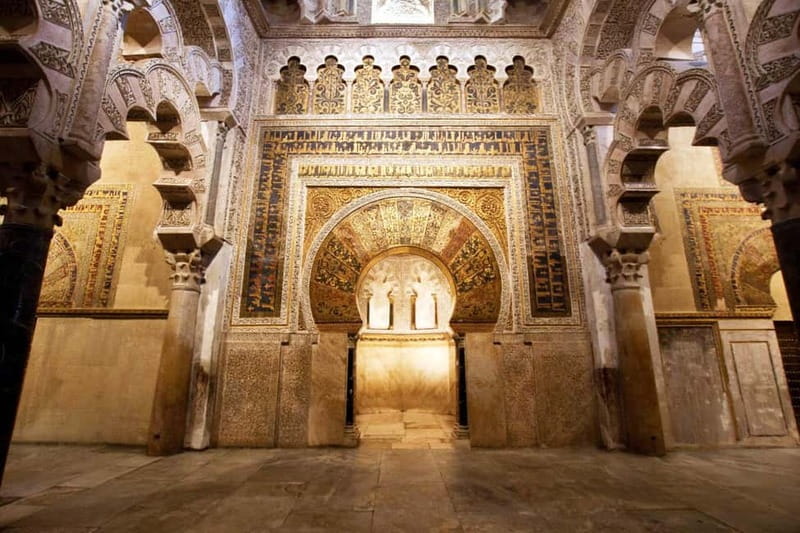
The striking thing about this Córdoba tour is the contrast between its two monuments. Inside the Mosque-Cathedral, hundreds of red-and-white arches trace the city’s Islamic past, while a Christian cathedral rises at the center. At the Alcázar, royal rooms, defensive walls, and formal gardens tell a different part of Córdoba’s story.
I like the way the tour connects the Visigothic Basilica of San Vicente, the mosque built under Emir Abderramán I, later extensions, and the Christian cathedral. I also like that historians lead the visits rather than giving you only a quick route through the buildings.
The main caution is pace. One visitor found the guide kind but spoke continuously and made it hard to connect the events of Spanish history. If you need pauses, questions, or a slower explanation, say so early.
Key points to know before booking
- Two major monuments in three hours: The tour covers the Mosque-Cathedral and Alcázar of the Christian Kings in one compact visit.
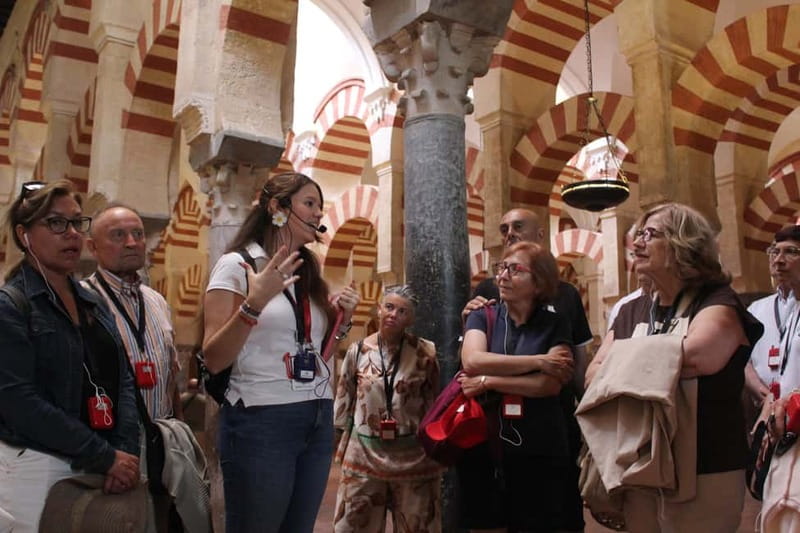
- A historian leads the tour: Explanations are available in Spanish, English, or French.
- The Mosque-Cathedral has several layers: You will hear about the Visigothic church, the original mosque, later Islamic expansions, and the Christian cathedral.
- The Alcázar links palace and prison: Its story includes the Catholic Monarchs, the Inquisition, and the royal reception connected with Christopher Columbus.
- Timing changes by day: Morning, afternoon, and Sunday schedules use different meeting times and different monument orders.
- Audio support is included for larger groups: Groups of more than 10 receive audio equipment.
Why these two Córdoba monuments belong together
Córdoba is easiest to understand when you see its monuments as parts of one long story. The Mosque-Cathedral shows how one sacred site changed as political and religious power shifted. The Alcázar shows how later Christian rulers used Córdoba as a royal center.
That makes this pairing useful if you have only a short time in the city. You are not simply checking off two famous buildings. You are following the city from Visigothic worship, through the Islamic period, to Christian rule and royal government.
The three-hour format is also practical. It gives you a guide for the main facts without taking up an entire day. I would not expect every side detail or every room to receive a long explanation, but you should come away with a working map of Córdoba’s past.
The tour is conducted in one language, with Spanish, English, and French available. That matters because these monuments can be confusing without context. The architecture changes quickly, and the political story covers many centuries. A historian can help you understand why those changes happened rather than leaving you to admire the arches and gardens without a larger picture.
More Guided Castle Tours in Spain
- Cordoba: Alcazar Guided Tour and Skip-the-Line Ticket
★ 4.2 · 1,792 reviews - Cordoba: Alcazar of Christian Monarchs 1–Hour Guided Tour
★ 4.3 · 583 reviews - Córdoba Guided Tour of the Mosque, Jewish Quarter & Alcazar
★ 4.5 · 495 reviews
Entering the Mosque-Cathedral through the Puerta del Perdón
The Mosque-Cathedral is the stronger half of the tour for many visitors. Your meeting point for this visit is the Puerta del Perdón, the Gate of Forgiveness. This is also where afternoon and Sunday schedules begin, so check your booking carefully before setting out.
Inside, the guide begins with the site’s earliest known Christian layer, the Visigothic Basilica of San Vicente. Remains of the basilica are still preserved. This first stage matters because it shows that the site was already a place of worship before the Islamic mosque was built.
The next part follows the construction of the primitive mosque under Emir Abderramán I. The tour then traces later extensions, continuing through the period of Almanzor. This sequence helps you read the building as an expanding city’s changing place of worship, not as a single project completed at one time.
I especially like this approach because the architecture makes more sense once you know what to look for. The mosque is not just a hall of repeated arches. Its sections reflect different rulers, different building campaigns, and the growing importance of Córdoba.
The guide then explains the Christian reconquest and the building’s conversion into a cathedral. Several naves from the extension ordered by Caliph al-Hakam II were used for Christian liturgical celebrations. Later, the current cathedral transept and central structure were built within the former mosque.
That clash of forms is the building’s defining feature. Islamic arches, Christian chapels, and the cathedral structure occupy the same sacred space. You may find it beautiful, awkward, or both at once. A good explanation helps you understand that the tension is part of the monument’s meaning.
Allow yourself time to look up and around while the guide speaks. The repeated arches can make the interior feel almost endless, while the cathedral center changes the scale and mood. If your guide speaks quickly, do not wait until the end to ask for a short pause. The content is substantial, and the building is too important to experience as a stream of dates.
Following the Alcázar from royal residence to prison
The second visit takes place at the Alcázar of the Christian Kings, one of Córdoba’s best-known monuments. The meeting point is beside the Sotos de la Albolafia sign, in front of the main entrance to the Alcázar.
The palace has served several roles. It was home to the Catholic Monarchs for more than eight years, later served as an Inquisition headquarters, and was used as a prison. Those changes give the building a darker and more practical story than its gardens might suggest.
A historian can help you connect the palace to the wider political history of Córdoba. The Alcázar was not only a pretty royal residence. It was a place where power was displayed, decisions were made, and institutions such as the Inquisition operated.
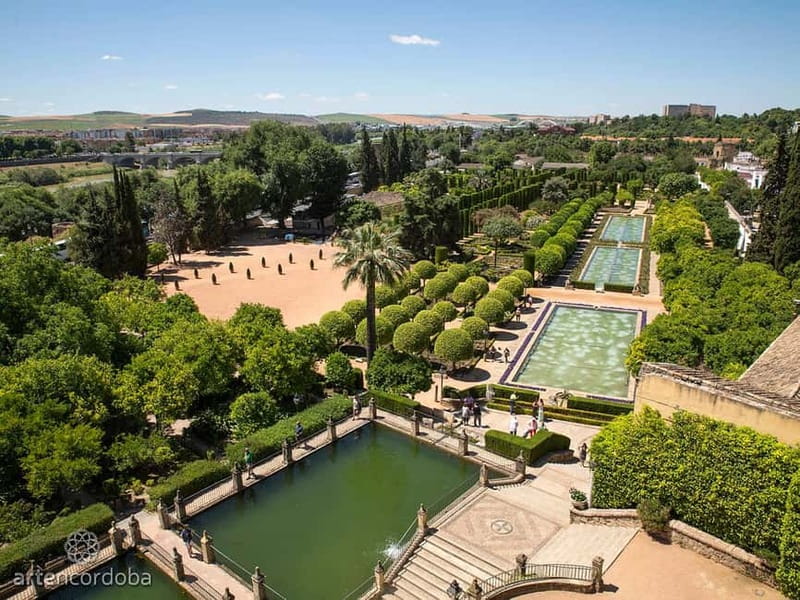
The gardens are a major part of the visit. You stroll beside pools and formal plantings, with the palace close by. The route also includes the monument connected with the first royal reception for Christopher Columbus. That detail places the Alcázar within the age of exploration and royal expansion.
I like the contrast with the Mosque-Cathedral. The mosque visit is mainly about sacred architecture and layers of worship. The Alcázar visit is more about monarchy, administration, imprisonment, and public ceremony. Together they give you two different ways to understand Córdoba.
The Alcázar is also a place where a rushed explanation can leave you with a list of names but little sense of cause and effect. Try to listen for the basic thread: who controlled Córdoba, how they used the building, and what changed when its role changed.
How the schedule works on morning, afternoon, and Sunday visits
The tour does not use one identical timetable every day. You have booked a set of two visits, and the meeting order depends on the schedule.
For a morning booking, you meet at 10:15 beside the Sotos de la Albolafia sign, in front of the Alcázar’s main entrance. The Alcázar comes first. You then meet at the Mosque-Cathedral’s Puerta del Perdón at 12:30.
For an afternoon booking, you begin at the Puerta del Perdón at 16:00 for the Mosque-Cathedral. The Alcázar follows at 18:30, with the meeting point beside the Sotos de la Albolafia sign in front of the main gate.
Sunday has its own schedule. You meet at the Puerta del Perdón at 9:30 for the Mosque-Cathedral, then go to the Alcázar meeting point at 11:50.
This is one of the most important practical details. Do not assume the two monuments are visited in the same order every day. Check the exact schedule attached to your booking, and arrive at the correct monument rather than simply heading to whichever site is closest.
The activity ends back at the meeting point. Since both monuments are in Córdoba’s central historic area, the two-part structure avoids the need for a separate transfer between them. The information provided does not specify a private vehicle or transport service, so plan on moving between the stated meeting points on foot.
More Alcazar tours around Cordoba:
- Córdoba: Jewish Quarter, Mosque, and Alcázar Tour
★ 4.6 · 5,143 reviews - Córdoba: Mosque-Cathedral, Jewish Quarter and Alcázar Tour
★ 4.6 · 1,719 reviews - Córdoba: Mosque-Cathedral and Alcazar Tour
★ 4.5 · 637 reviews - Córdoba: Almódovar Castle Entrance Ticket
★ 4.6 · 493 reviews
Is three hours enough for both monuments?
Three hours is enough for an introduction, but it is not an all-day study of Córdoba. That is the tradeoff.
I would choose this length if you want a strong first look at the two headline sites, especially if your time in Córdoba is limited. The guide gives you the main construction stages at the Mosque-Cathedral, then the main political roles of the Alcázar. You can return later to whichever building holds your attention.
I would be more cautious if you prefer long quiet periods, detailed art history, or plenty of time for photographs. The material is dense, and the tour covers two major monuments in one sitting. A guide who keeps talking without pauses can make it hard to absorb the connections.
This is also a tour for people who want the story explained aloud. If you already know the history of Al-Andalus, the Christian reconquest, and the Catholic Monarchs, some of the overview may feel familiar. If those subjects are new to you, the historical framework can be very useful, provided the pace suits you.
The strongest feedback points to the explanations and connections as the tour’s best feature. One five-star assessment specifically praised how informative the visit was and how well it explained relationships between events. That is exactly where a historian-led tour earns its place.
Value, tickets, and what you are paying for
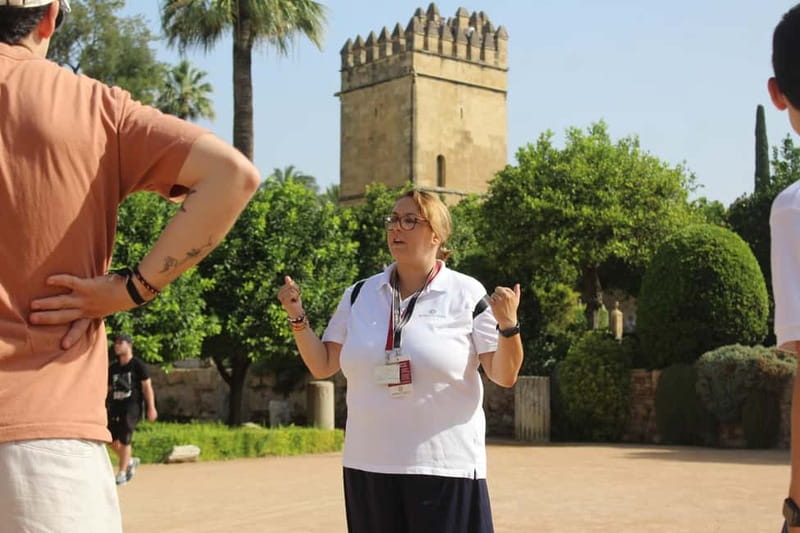
Tickets are included, as is a monolingual guided visit. Audio equipment is provided for groups larger than 10, which should make it easier to hear when the group is large.
The value depends on how much help you want inside the monuments. If you only want admission, a guided tour may feel expensive. One price example was 84 euros for two people, while the Alcázar entrance alone was described as 7 euros. That comparison makes the concern clear: much of your payment is for the guide, organization, and explanations, not simply the ticket.
I would book it if you want the history joined together and prefer not to research the monuments in advance. I would skip it if you mainly want to enter, wander at your own speed, and read on your own.
The guide’s ability to judge the group matters. A friendly historian who explains the links clearly can make the cost worthwhile. But if the talk becomes a nonstop recital, you may leave with plenty of information and a weak sense of how the pieces fit. Ask for clarification when needed. You are paying for access to a human guide, so use that opportunity.
Free cancellation is available up to 24 hours before the activity for a full refund. You can also reserve now and pay later, which helps if your Córdoba plans are still shifting.
Who will enjoy this Córdoba tour most?
I would recommend it to first-time visitors who want the two essential monuments explained in one compact outing. It also suits anyone who finds architecture easier to understand with a clear timeline.
History-minded visitors should get the most from the Mosque-Cathedral section. The route covers the Visigothic remains, Abderramán I’s mosque, successive expansions, Almanzor’s period, the Christian conversion, and the later cathedral. That is a lot of ground, but it gives you a useful structure for looking at the building.
The Alcázar section works well for people interested in royal power and Córdoba’s later Christian history. Its links with the Catholic Monarchs, the Inquisition, prison use, and Columbus provide more than a garden walk.
I would think twice if you dislike fixed schedules or need a slow pace. The tour has set meeting times, and the two monuments demand attention. It is also less suitable if you want a guide who will tailor every explanation to your background, since the information suggests a standard historical presentation.
Should you book the Mosque-Cathedral and Alcázar tour?
Book it if you want two major Córdoba monuments in three hours, need the history explained in English, Spanish, or French, and value a historian’s interpretation over independent wandering.
The best reason to choose it is the connection between the sites. You see how Córdoba’s sacred center changed from Visigothic basilica to Islamic mosque to Christian cathedral, then visit a palace tied to Christian monarchs, the Inquisition, prison life, and Columbus.
Pass on it if the price feels high for a short visit, or if you prefer to set your own pace. The tour’s main weakness is not the monuments but the possibility of a fast, uninterrupted explanation. Arrive ready to ask questions and request a moment to catch up.
For a first visit to Córdoba, I think the pairing makes sense. You get the city’s most important architectural story and its royal story in one organized morning or afternoon.
FAQ
How long does the guided visit last?
The activity lasts three hours and includes visits to both the Mosque-Cathedral and the Alcázar of the Christian Kings.
Which languages are available?
The live guide is available in Spanish, English, and French. The tour is monolingual.
Where does the morning tour begin?
For a morning booking, meet at 10:15 beside the Sotos de la Albolafia sign, in front of the Alcázar’s main entrance. The Mosque-Cathedral visit begins at the Puerta del Perdón at 12:30.
Where does the afternoon tour begin?
The afternoon schedule begins at the Mosque-Cathedral’s Puerta del Perdón at 16:00. The Alcázar visit begins at 18:30 beside the Sotos de la Albolafia sign, in front of the main gate.
What are the Sunday meeting times?
On Sunday, meet at the Mosque-Cathedral’s Puerta del Perdón at 9:30. The Alcázar visit begins at 11:50 beside the Sotos de la Albolafia sign, in front of the main gate.
Are tickets included?
Yes. Tickets are included, and audio equipment is provided for groups larger than 10.
More Guided Castle Tours in Cordoba
- Córdoba: Mosque-Cathedral & Alcazar Guided Tour
★ 4.6 · 383 reviews - Alcazar of Cordoba Entry Ticket and Guided Tour
★ 4.3 · 372 reviews - Cordóba: Gardens & Fortress of Catholic Monarchs Guided Tour
★ 4.3 · 336 reviews - Córdoba: Alcázar and Jewish Quarter 2-Hour Guided Tour
★ 4.2 · 50 reviews
New castle tours around Cordoba
- Córdoba: Mosque and Alcazar Private Tour with tickets★ 5.0 · 5 reviews
- Cordóba: Gardens & Fortress of Catholic Monarchs Guided Tour★ 4.3 · 336 reviews
- Cordoba: Alcazar of The Christian Monarchs Tickets and Tour★ 3.9 · 94 reviews
- Córdoba: Mosque-Cathedral & Alcazar Guided Tour★ 4.6 · 383 reviews
- Córdoba: Mosque, Jewish Quarter and Alcázar 3-Hour Tour★ 4.7 · 377 reviews
- Cordoba: 2.5-Hour Guided Jewish Quarter and Alcazar Tour★ 4.3 · 56 reviews
- Alcazar of Cordoba Entry Ticket and Guided Tour★ 4.3 · 372 reviews
- Córdoba: Alcázar and Jewish Quarter 2-Hour Guided Tour★ 4.2 · 50 reviews
Alcazar Tours, compared.
Seville: Alcázar, Cathedral & Giralda Skip-the-Line Tour
Read our review →
Seville: Cathedral, Giralda & Alcazar Entry With Guided Tour
Read our review →
Madrid: Segovia and Toledo Tour, Alcazar, and Cathedral
Read our review →
Seville: Priority Access Cathedral, Giralda & Alcázar Tour
Read our review →
Córdoba: Jewish Quarter, Mosque, and Alcázar Tour
Read our review →
Seville: Alcázar and Cathedral Entry Ticket and Guided Tour
Read our review →
Alcazar and Cathedral of Seville Tour with Skip the Line Tickets
Read our review →Browse the lists this tour appears in