
Review · ITALY
Bari: Norman-Swabian Castle Entry Ticket
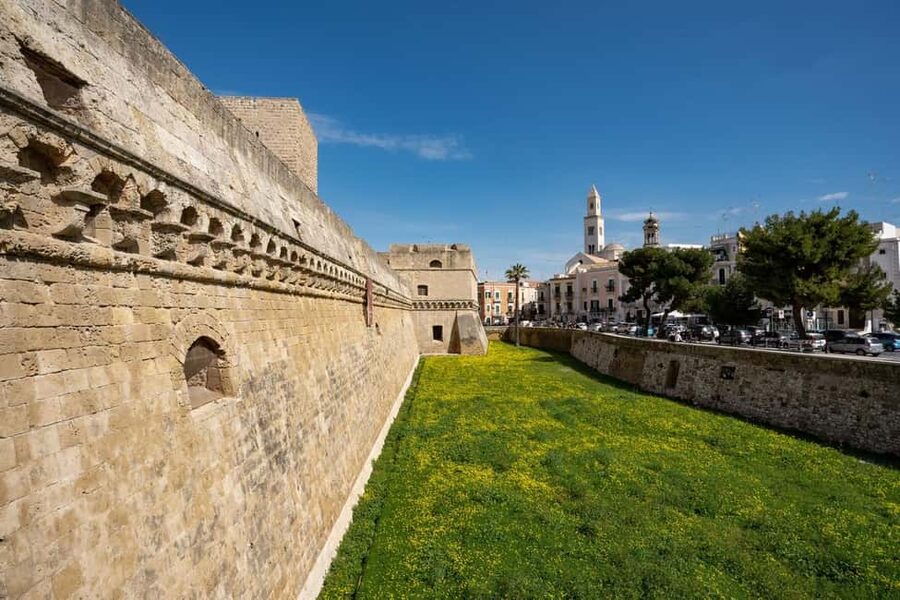
Bari’s Swabian Castle gives you a compact lesson in southern Italy’s changing rulers. The fortress began in 1131 under Ruggero II, was rebuilt by Frederick II, and later became a more refined home for Isabella of Aragon and Bona Sforza. The architecture tells the story, especially around the entrance portal, atrium, and loggia.
I like the way the visit combines big political history with small objects, from Renaissance ceramics and jewelry to wooden models of nearby castles. I also like the optional audio guide, which helps you make sense of rooms that might otherwise feel spare. The main drawback is simple: at around $14 for the adult ticket, and another €6 for the audio guide, the castle may feel expensive if you expect a packed museum with many furnished rooms.
Key points to know before entering
- A fortress with several lives: See how the Norman stronghold changed under Frederick II and later became a Renaissance residence.
- A central Bari location: The castle sits in the old part of the city between the cathedral and the docks.
- Small collections with useful context: Look for Renaissance ceramics, jewelry, and wooden models of castles in Bari, Barletta, and Monopoli.
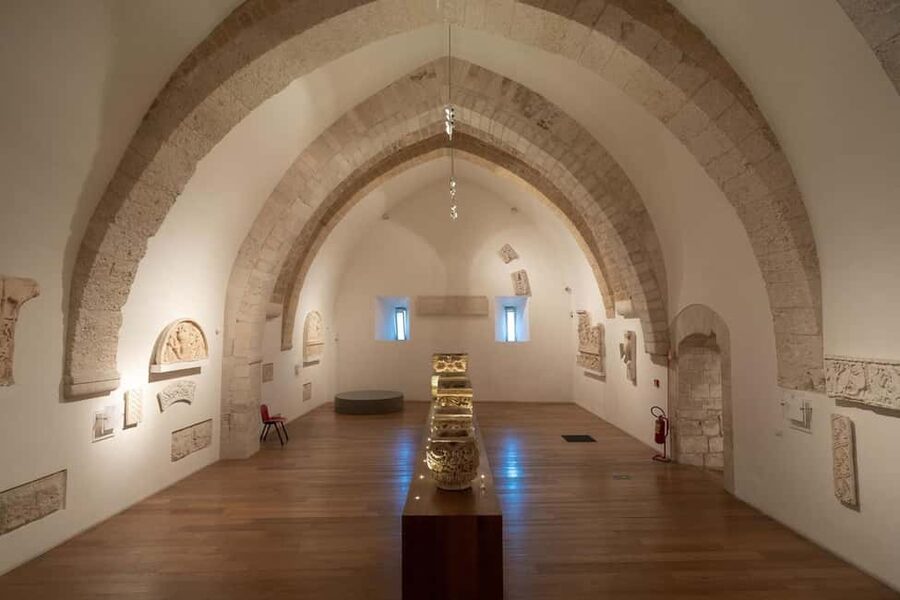
- The Gipsoteca adds a different angle: This 2011 collection uses plaster casts to show important monuments and places of worship in Puglia.
- An audio guide is worth considering: It is available in English, Italian, French, Spanish, and German for an added €6.
- Timing matters: Your selected entry time must be respected, and opening hours can change.
Bari’s castle between the cathedral and the docks
The Swabian Castle is easy to place within Bari’s old core. It sits between the cathedral and the harbor area, so it fits naturally into a walk through the historic center rather than requiring a separate outing across town.
The setting matters. This is not an isolated palace placed in a garden. It is a defensive building tied to the city’s older streets, religious center, and waterfront. After seeing the cathedral, you can use the castle to shift your attention from church power to military and royal power.
The building’s shape is immediately imposing. Its main form is a trapezoid, a practical military design that gives the castle a firm, enclosed feel. The outer structure is more about strength than decoration, but the details inside reveal that the building did not remain frozen in its first role.
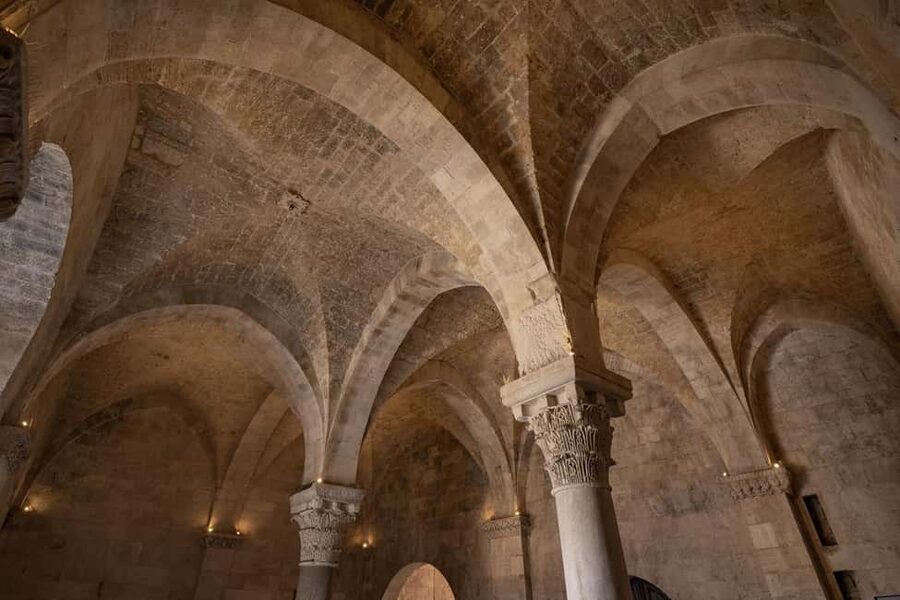
Give yourself time to look closely at the stonework. Architraves, cornices, corbels, and capitals appear around the entrance areas and loggia. These details are useful clues: the castle may have begun as a fortress, but later rulers wanted the building to communicate status as well as force.
More Castle Entry Tickets in Italy:
- Milan: Sforza Castle Entry Ticket with Digital Audio Guide
★ 4.0 · 2,675 reviews - Trieste: Miramare Castle & Museum Entry Ticket & Audio App
★ 4.2 · 213 reviews - Manta: Manta Castle Entry Ticket
★ 4.5 · 26 reviews
From Ruggero II to Frederick II
Ruggero II built the original castle in 1131 to secure the Norman conquest of Bari. That date places the building in a period when control of the city had to be made visible and permanent. The castle was not simply a royal address. It helped seal a political takeover.
In the 13th century, Frederick II of Swabia rebuilt the castle. His work is especially visible in the grand entrance portal, the atrium, and the loggia. You can read these sections as a blend of defense and ceremony. A ruler needed a stronghold, but he also needed an impressive route into the building.
The audio guide can be particularly helpful here. Without explanation, an arch or capital can blur into the general stonework. With historical context, you can connect the architectural details to Frederick II’s intervention and understand why particular parts of the castle receive attention.
This is one of the best reasons to add the audio option. The castle’s history involves several rulers and phases of construction, so a spoken explanation gives the visit a clear thread. You can choose English, Italian, French, Spanish, or German. The additional cost is €6.
What to look for in the entrance areas
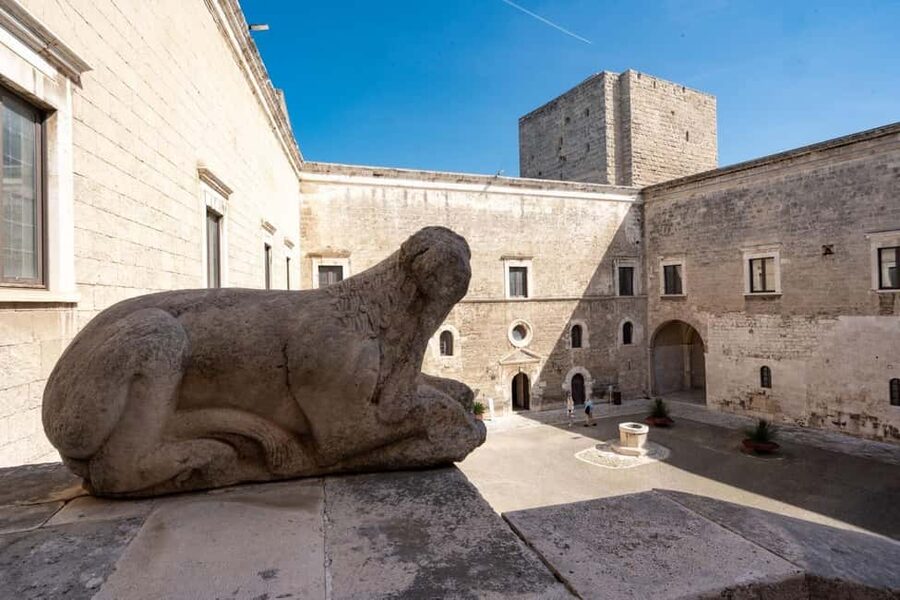
Start with the majestic entrance portal. It is one of the clearest places to see the changes ordered by Frederick II. Rather than rushing through to the collections, pause here and inspect the arrangement of the stone elements.
The atrium continues that first impression. Its scale and formal design show that the castle was meant to control movement and make an impact. You are moving through a building where access itself had meaning. A fortress protected its occupants, but a royal residence also staged the arrival of important people.
The loggia brings a lighter architectural note. Look at the relationship between the arches, architraves, cornices, corbels, and capitals. These details reward a slower pace. You do not need a specialist’s background to enjoy them, but you do need to avoid treating the castle as a quick photo stop.
The building is not presented as a single-period monument. Its appeal comes from the layers. Norman military beginnings, Swabian rebuilding, and later Renaissance changes all occupy the same structure. That layered design is the main reason to visit, especially if you enjoy buildings that show political change through stone.
Isabella of Aragon and the Renaissance rooms
The castle changed character again in the 16th century under Isabella of Aragon and her daughter, Bona Sforza. They turned the austere military building into a more refined Renaissance residence.
This change gives the visit its human side. The castle was no longer only about conquest and defense. It became a place associated with court life, culture, poets, and artists. You can look at the surviving architectural setting with that shift in mind: rooms and details were meant to support a more polished way of living.
Do not expect every room to feel like a fully furnished palace interior. The collections and installations do much of the work, explaining how the fortress evolved through the centuries. For many people, this is more useful than a room filled with furniture but little explanation.
The transition from fortress to residence also helps you understand why the castle’s appearance can feel uneven. Some sections remain stern and military, while others carry Renaissance touches. That contrast is not a flaw in the experience. It is the point.
More castles to explore around Italy:
- Milan: Sforza Castle and Michelangelo’s Pietà Rondanini Tour
★ 4.7 · 1,119 reviews - From Siena: Chianti and Castles Tour with Wine Tastings
★ 4.6 · 631 reviews - Milan: The Last Supper & Sforza Castle Guided Tour
★ 4.6 · 610 reviews - Milan: Last Supper and Sforza Castle Guided Tour
★ 4.6 · 498 reviews
Ceramics, jewelry, and three wooden castles
Inside, you will find several collections that make the historical story more concrete. Renaissance-era ceramics and jewelry give you a sense of the decorative side of the building’s later life. These objects are smaller than the walls around them, but they help explain how an austere stronghold became a courtly residence.
The wooden models of the castles of Bari, Barletta, and Monopoli are especially useful. A model can show relationships that are hard to grasp from a single building. It gives you another way to think about fortifications across the region and connects Bari’s castle with other defensive sites in Puglia.
The displays and installations are among the strongest parts of the visit because they explain the castle’s development rather than leaving you alone with bare rooms. You can follow the fortress through its changes and see how its role shifted over time.
If you have a strong interest in military architecture, you may want more extensive exhibits than this visit provides. The collection is not described as enormous, and the castle itself remains the main attraction. Still, the objects add welcome texture and help prevent the tour from becoming only a walk through stone corridors.
The Gipsoteca and Puglia’s monuments
The Gipsoteca, opened in 2011, offers a different experience from the castle rooms. It contains plaster casts of important monuments and places of worship in Puglia.
This collection is valuable because it broadens the visit beyond Bari. Instead of seeing only one castle, you get a visual introduction to architectural details from around the region. Plaster casts can show sculpture, ornament, and building features at close range, making them easier to study than details high on a church facade.
The Gipsoteca may appeal most to you if you like architecture, sculpture, or regional art. It also works well for anyone planning more time in Puglia. The casts can help you notice similar forms when you later visit other towns and churches.
Do not treat this section as a quick add-on. The main castle rooms explain one building’s history, while the Gipsoteca widens your view to Puglia’s monuments. Together, they make the visit more than a standard fortress entry.
Is the €10 ticket good value?
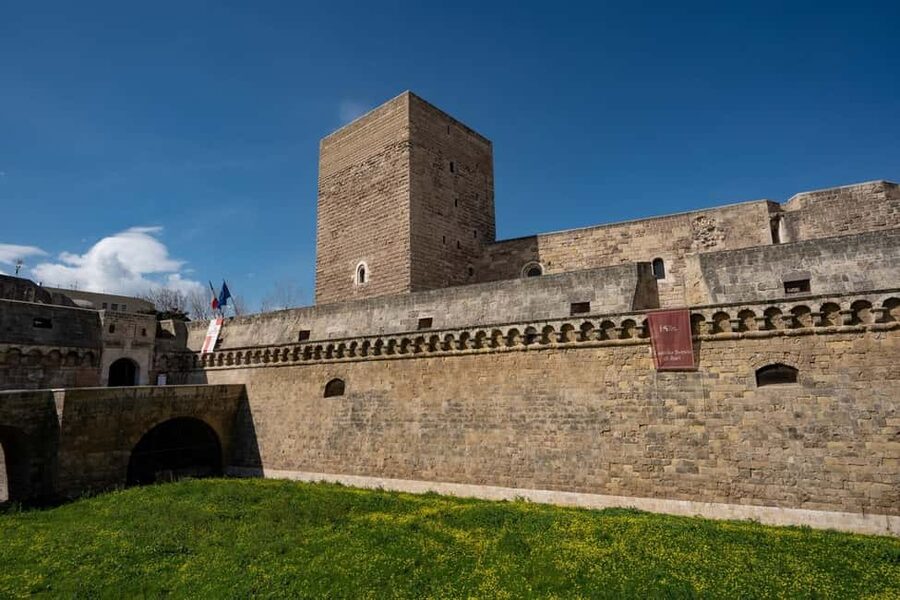
The stated adult admission is €10, or roughly $14 depending on the booking price and exchange rate. The audio guide costs an additional €6. Meals, drinks, transport, and souvenirs are not included.
For the base ticket, value depends on how you like to visit museums. If you enjoy architecture, political history, and exhibits that explain a building’s changes, the price is reasonable. You are paying for access to a major historic structure, its interior collections, and the Gipsoteca, not simply an exterior view.
The audio guide changes the calculation. At €6 extra, it adds a noticeable amount to the ticket, but it may be worthwhile if you want the Norman, Swabian, and Renaissance phases explained as you move through the building. If you have already read about Frederick II or are comfortable exploring at your own pace, you may prefer the cheaper option.
The castle also offers free admission on the first Sunday of each month and on April 25, June 2, and November 4. Those dates can improve the value, but opening arrangements may vary, so check before setting your plans around a free visit.
Timing, access, and practical planning
The ticket is valid for one day, with entry tied to the time you choose. Respect that entry time. The opening hours can change according to museum or site requirements, so confirm the current schedule before you go.
No transportation is included. Since the castle is in Bari’s older central area, you will need to arrange your own way there, but the location makes it practical to pair with nearby sights. The cathedral and docks are specifically close by, giving you a useful route through this part of the city.
The site is wheelchair accessible. That makes the visit possible for a wider range of visitors, though the information provided does not describe every interior route or facility. If you need precise access details, confirm them before booking.
The activity is sold by GetYourGuide Tours & Tickets GmbH. Free cancellation is available up to 24 hours before the visit for a full refund. Confirmation is sent within 48 hours of purchase, so do not leave the booking until the last possible moment if you need the ticket quickly.
Who will enjoy this castle most?
I would recommend the visit to you if you like historic buildings where the structure itself carries the main story. It suits people interested in Norman and Swabian rule, Frederick II, Renaissance courts, and Puglian architecture.
It is also a good choice if you want a self-guided stop with a clear location in the old city. You can explore at your own pace, then use the audio guide when you want more explanation. The optional format keeps the base visit simple while still offering help in several languages.
Families and casual sightseers may enjoy the wooden castle models and the visual installations, especially if a long text-heavy museum is not appealing. The Gipsoteca adds another set of objects to look at and can give younger visitors a more concrete sense of Puglia’s monuments.
I would think twice if you want a large collection, many furnished rooms, or a guided tour led by a named expert. No guide’s name is provided, and the experience is centered on entry to the castle with an optional audio guide. One poor rating described the visit as offering too little for the price, so expectations matter.
Should you book the Swabian Castle?
Book it if you are already exploring Bari’s old center and want a focused look at the city’s Norman, Swabian, and Renaissance chapters. The strongest features are the historic architecture, the installations showing the castle’s evolution, and the mix of smaller collections with the Gipsoteca.
Choose the audio guide if the building’s many phases sound confusing or if you want a fuller explanation in English or another supported language. Skip it if you prefer to look around independently and are mainly interested in the castle’s stonework.
At about $14 for the adult ticket, this is not Bari’s cheapest stop, but it offers more than an exterior photograph. I would make the visit when the castle’s layered history interests you, especially if you can use a free-admission date. If you need a large, object-packed museum, this may feel brief for the cost.
FAQ
Where is the Swabian Castle of Bari?
It is in the oldest part of Bari, between the cathedral and the docks.
What does the castle ticket include?
The adult entry ticket includes admission to the Swabian Castle and its interior collections. Meals, drinks, transportation, and souvenirs are not included.
How much does adult admission cost?
The stated adult ticket price is €10, which is approximately $14 depending on the exchange rate and booking price.
Does the castle offer an audio guide?
Yes. An optional audio guide is available for an additional €6.
Which languages are available for the audio guide?
The audio guide is available in English, Italian, French, Spanish, and German.
Is the castle wheelchair accessible?
Yes, the activity is listed as wheelchair accessible.
Can I cancel for a refund?
Yes. You can cancel up to 24 hours before the visit for a full refund.
Are there free admission dates?
Admission is free on the first Sunday of each month and on April 25, June 2, and November 4. Opening arrangements may change, so check the current details before visiting.
New castle tours around Italy
- Pastrengo: e-bike tour and wine tasting in the Castle★ 4.8 · 9 reviews
- Naples Express Tour: Castles, Legends & the Gulf★ 5.0 · 9 reviews
- Naples: San Martino and Sant’Elmo Castle Guided Tour★ 4.9 · 48 reviews
- Montone: Medieval Dinner in Cardaneto Castle★ 5.0 · 2 reviews
- Montone: Pasta Making and Dinner at Cardaneto Castle★ 5.0 · 4 reviews
- Montalcino: Brunello Wine Tasting & Lunch in a Tuscan Castle★ 4.6 · 324 reviews
- Montalcino: Castle and Vineyards Tour with Tasting★ 4.2 · 55 reviews
- Miramare: The most romantic, beautiful and sad castle.★ 4.2 · 6 reviews
Castle Entry Tickets, compared.

Edinburgh Castle: Guided Walking Tour with Entry Ticket
Read our review →
Prague: Castle Tour with Local Guide and Entry Ticket
Read our review →
Prague Castle 2.5-Hour Tour Including Admission Ticket
Read our review →
Prague: Prague Castle and Lobkowicz Palace Entry Tickets
Read our review →
Seville: Alcázar and Cathedral Entry Ticket and Guided Tour
Read our review →
Carcassonne: Castle and Ramparts Entry Ticket
Read our review →Browse the lists this tour appears in